How a Microscopic Foam Party Inside a Scramjet Could Revolutionize High-Speed Flight
Turning everyday plastic into rocket fuel. Yes, really.
Fueling engines for high-speed flight, like ramjets and scramjets, is a formidable challenge. These air-breathing engines operate at speeds where friction and air compression generate extreme temperatures, pushing traditional fuels to their limits.
So-called "endothermic fuels" can absorb some of this heat, but they often leave behind carbon deposits that clog injectors and reduce performance. This has forced scientists to look for unconventional solutions.
Enter a surprising candidate: common plastics.
Researchers are investigating materials like polypropylene (PP) and polystyrene (PS)—the same polymers found in everyday containers and packaging—as solid fuels for supersonic propulsion. By eliminating the need for complex injectors, these solid fuels could sidestep many of the problems plaguing their liquid counterparts.
But the process of using these plastics for propulsion is far more complex and fascinating than simply lighting them on fire. Our research exploring the combustion of these polymers reveals a hidden world of multiphase physics and counter-intuitive phenomena.
Here are five of the most surprising takeaways.
1. The Secret Isn't Just Fire, It's a Microscopic Foam Party
When polymers like polypropylene and polystyrene burn, they don't simply melt and vaporize. Instead, a thin, complex "foam-like decomposition layer" forms on the surface.
Scientists describe this as a "pseudo-gel" containing a mixture of both liquid polymer and gaseous bubbles of fuel. This microscopic foam layer is where the critical action happens—it is the essential bridge between the solid fuel and the gas-phase flame burning above it.
This changes our entire understanding of the combustion process. The performance of the fuel—how fast it burns and how efficiently it releases energy—is dictated by the intricate physics occurring within this tiny, multiphase region.
2. To Burn Fuel Faster, You Have to Slow the Bubbles Down
To understand the foam layer, we explored two different models for how the gas bubbles behave within the liquid polymer.
In the first model ("RhoU"), the gas bubbles were assumed to pass through the liquid unimpeded. In the second, more complex model ("V"), the bubbles were forced to move at the same speed as the surrounding liquid, effectively being dragged and slowed down by the viscous polymer.
The result was completely counter-intuitive.
The "V" model, where the bubbles are slowed, actually results in a more effective and faster burn.
By slowing the bubbles' transit through the foam, the gaseous fuel has more time to decompose while still inside the layer. This extended residence time allows the foam to reach higher temperatures, which accelerates the overall decomposition process.
3. Molecular "Stickiness" Can Matter More Than Bubbles
In analyzing the foam layer, we focused on two key parameters: bubble density (the number of bubbles per cubic meter) and the "sticking coefficient"—a measure of the probability that a gas molecule will "stick" to the liquid surface after colliding with it.
One might assume that creating more bubbles would increase the surface area for vaporization and thus have the biggest impact on the burn rate.
However, the sensitivity analysis showed something different. The sticking coefficient—that tiny, molecular-level property of "stickiness"—has a stronger effect on the fuel's regression rate than the density of the bubbles.
4. Taming Chaos with a Mathematical Shortcut
Modeling the decomposition of a polymer is an immense computational challenge. A single piece of plastic is made of a tangled mass of polymer chains of thousands of different lengths. Tracking every single one during pyrolysis is computationally impossible.
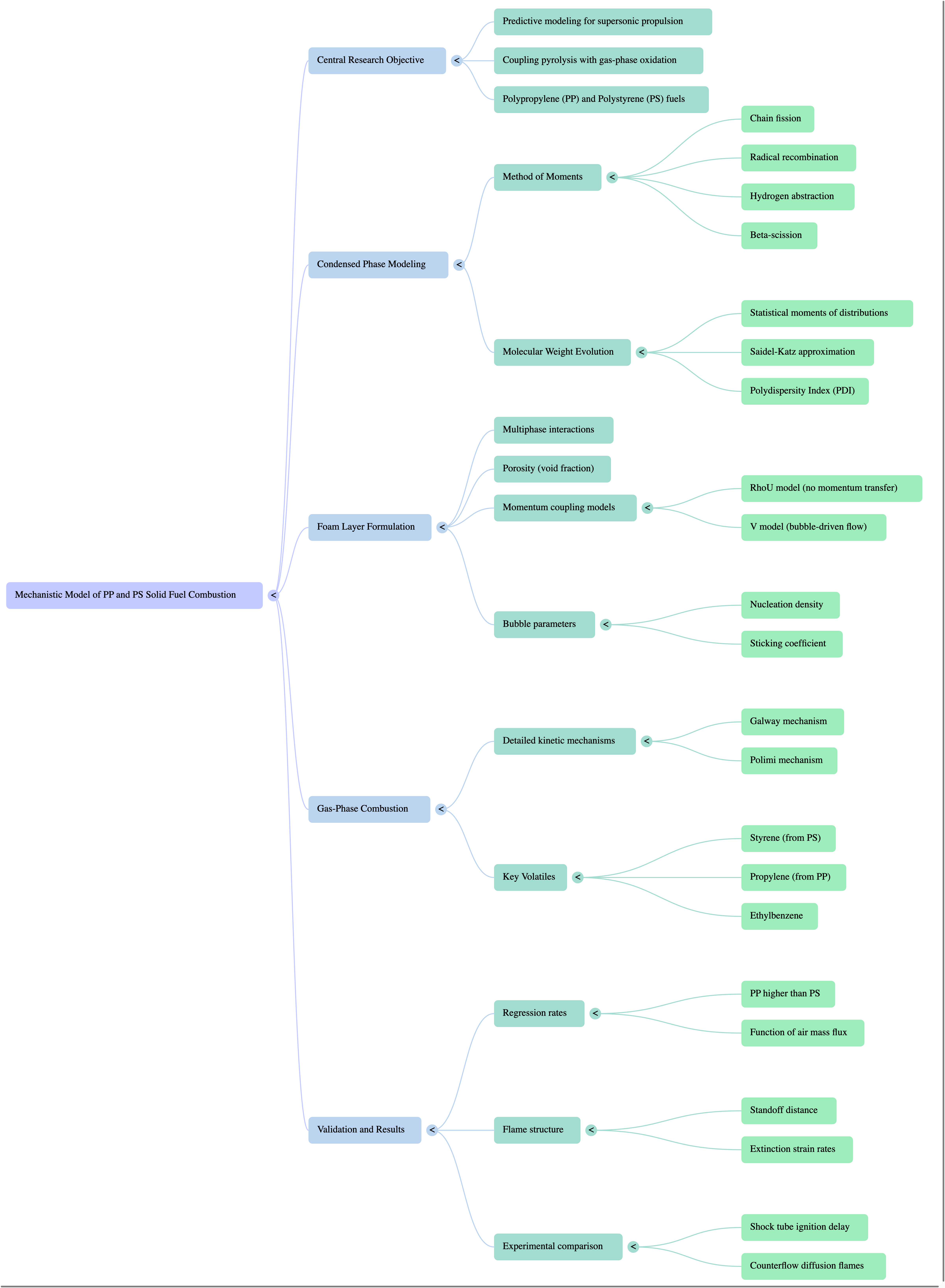
To overcome this, we used an elegant mathematical solution called the "Method of Moments."
Instead of tracking every individual polymer chain, this method tracks the statistical properties of the entire population of chains—reducing an impossibly complex system to a manageable set of equations.
5. Polypropylene Burns Hotter and Faster
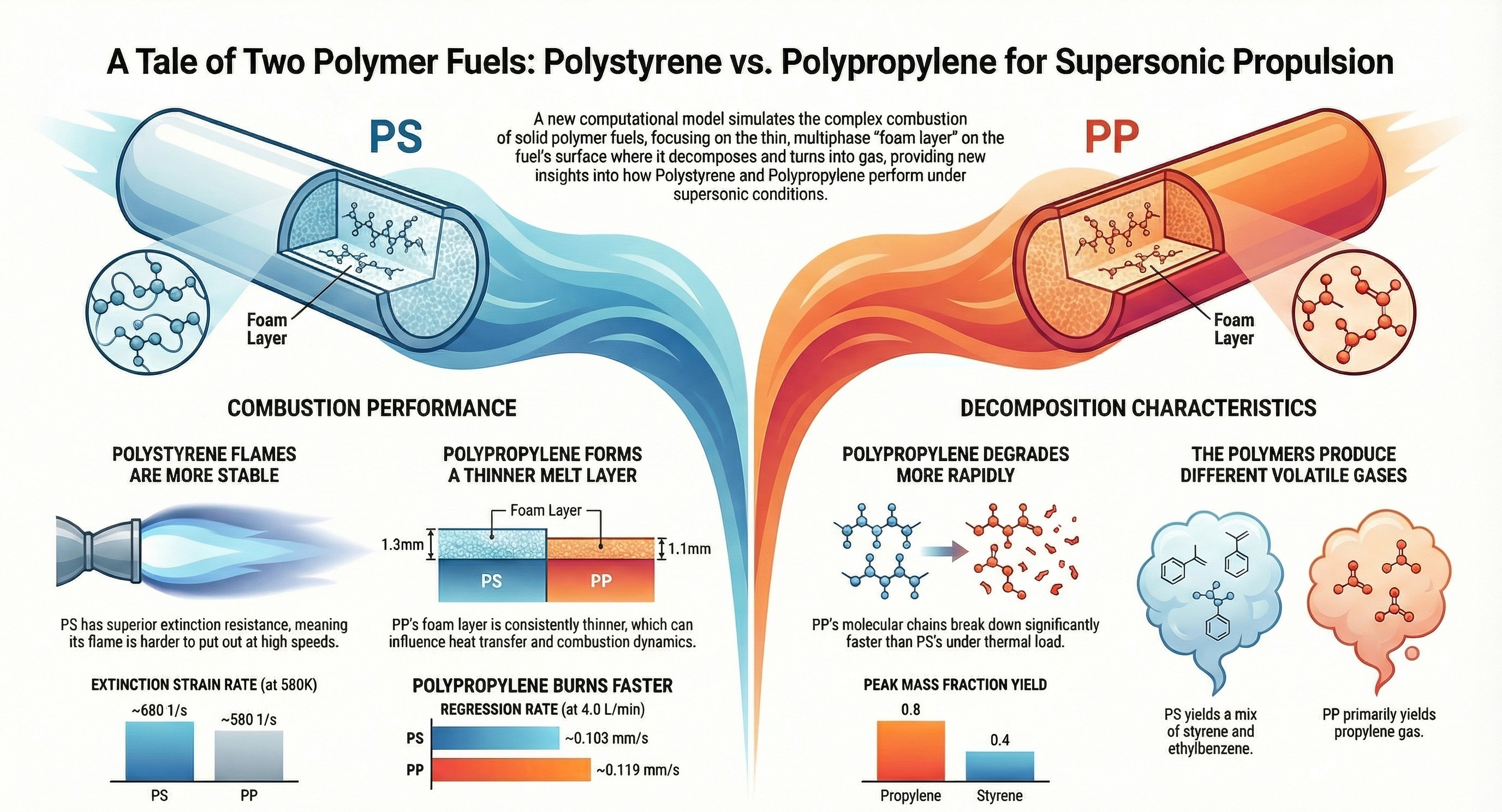
The study directly compared the performance of Polystyrene (PS) and Polypropylene (PP). The findings were clear: Polypropylene is the superior fuel.
PP exhibits superior regression rates, maintains a thinner foam layer, and has lower activation energy for decomposition. However, Polystyrene shows better resistance to flame blowout at higher strain rates—suggesting it might offer more stability under certain demanding flight conditions.
The Universe in a Burning Plastic
The investigation into burning common plastics for supersonic flight reveals that even a seemingly simple process holds incredible layers of complexity. What begins as a solid piece of polymer becomes a dynamic, microscopic world governed by multiphase foams, counter-intuitive physics, and elegant mathematical models.
It leaves you to wonder: what other profound scientific secrets are hiding in the common, everyday materials we take for granted?
If you're a visual learner, keep scrolling.